About Joseph Nicéphore Niépce
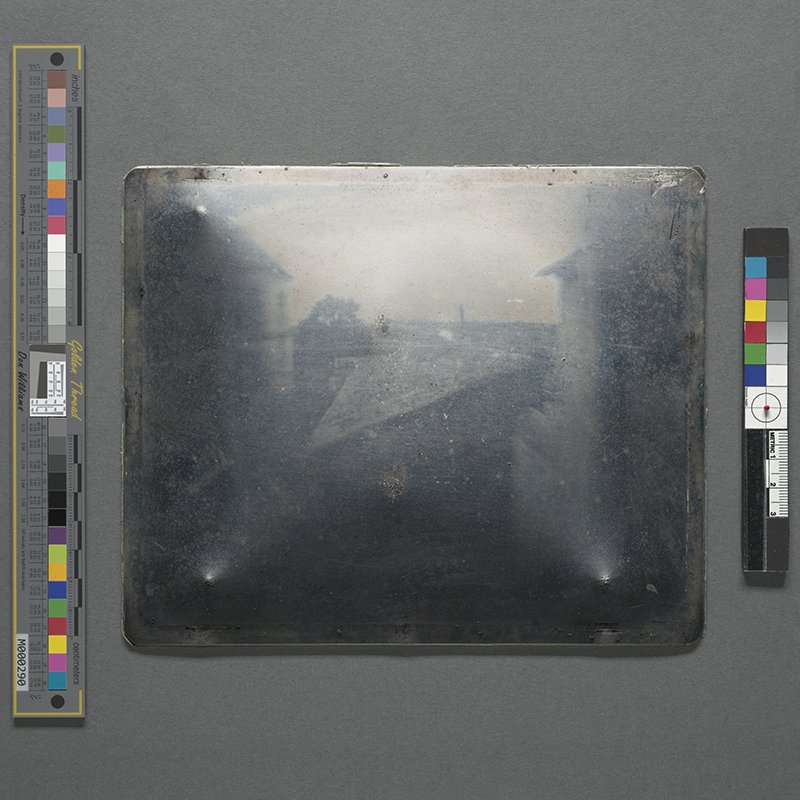
Joseph Nicéphore Niépce (1765–1833), a French inventor and pioneer of photography, is best known as the creator of the oldest known camera image still in existence, made in 1827.
Beginning in 1816 at his family estate in the Burgundy region of France, he tinkered with photo-etching and produced early camera images using the camera obscura (“dark chamber”), a device for capturing the natural phenomenon of light passing through a small hole in an enclosed chamber to project the view outside it onto its interior surface.
After years of experimentation, Niépce developed a process he named héliographie, or “sun writing.” By coating a polished pewter plate with light-sensitive bitumen and exposing it in a camera obscura for several days, he produced a lasting image of the view from his window in 1827—the first successful permanent photograph and a breakthrough that laid the foundation for photography worldwide.
He established a partnership in 1829 with French artist Louis-Jacques-Mandé Daguerre (1787-1851) who continued to develop the process after Niépce’s death and announced it to the French Academy of Sciences in 1839.
The Harry Ransom Center at the University of Texas at Austin purchased the photograph in 1963 as part of the Gernsheim Collection. Link to download the image.